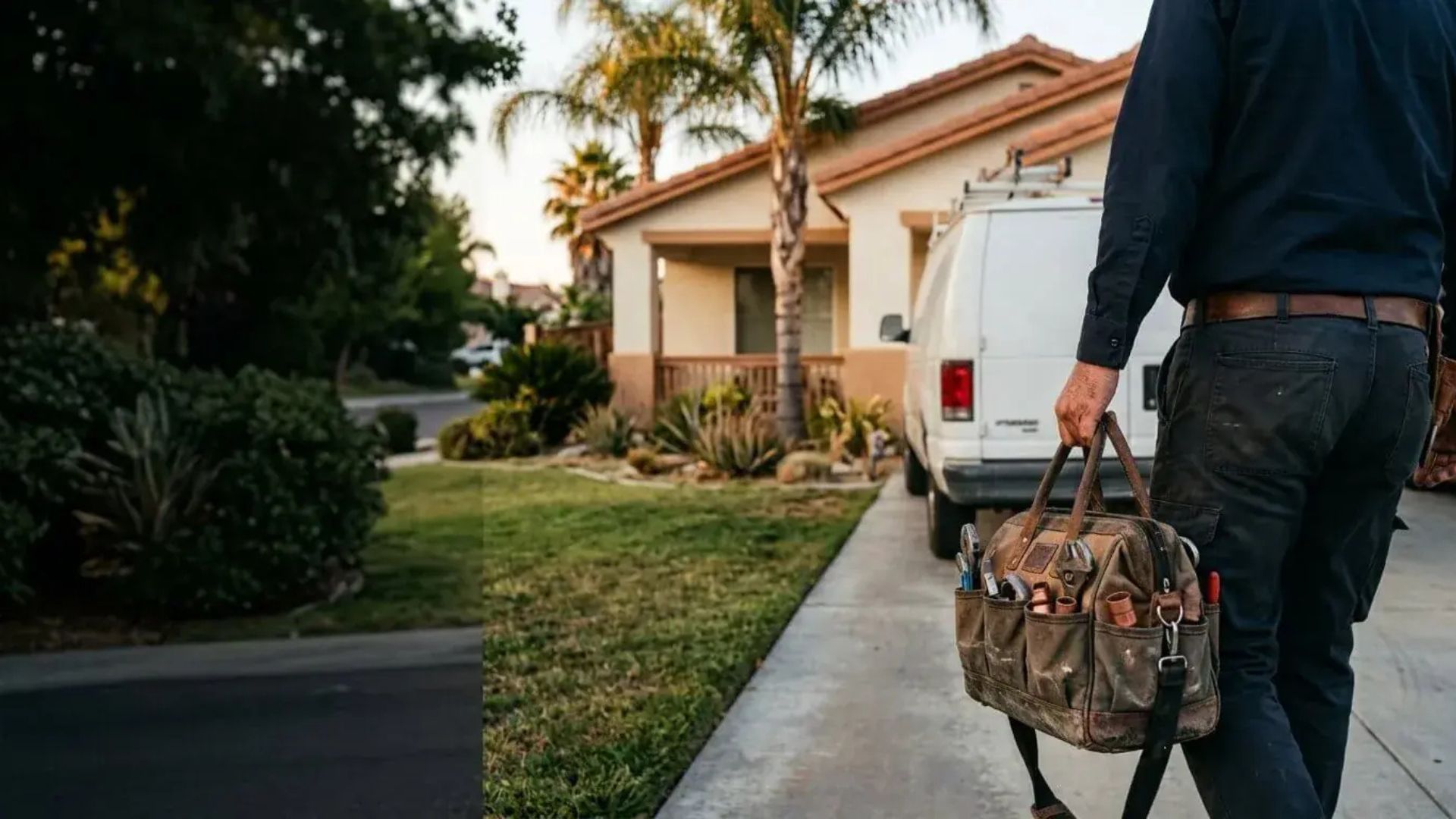
Signal Hill, California — Cooling & Heating Contractor
Air conditioning and heating service, explained with the panels off
Hill Side AC & Furnace works on condensers, evaporator coils, air handlers, furnaces, heat pumps, ductwork and thermostats across Signal Hill. Diagnosis first, then a plain explanation of what the system needs before any work starts.
Open 7am to 8pm, Mon to Sun
Services
What Hill Side AC & Furnace books
Six kinds of work homeowners call about most. Each one links to a section below that covers the equipment, the measurements involved and what you would notice at home.
-
Air conditioning repair
Condenser running but not cooling, warm supply air, ice forming on the suction line, a breaker that trips or a system that short cycles. Work starts at the thermostat and finishes with pressures, temperatures and amp draw.
-
Installation & replacement
Load calculation with manual J, matched indoor and outdoor sections, a line set brazed under nitrogen, a deep vacuum before charging, and startup readings recorded so the system can be compared against later.
-
Heating & heat pumps
Furnace ignition faults, ignitor and flame sensor service, heat exchanger inspection, plus heat pump defrost problems, reversing valve faults and auxiliary heat that stages in too early.
-
Ductwork & airflow
Static pressure across the filter and coil, crushed flex duct, leaking boots at the wall, missing returns, undersized runs and register balancing for the rooms that never keep up.
-
Seasonal maintenance
Filter, condensate pan and float switch, coil cleaning, capacitor and contactor checks, superheat and subcooling logged, and airflow readings written down for the next visit.
-
Thermostats & indoor air
Thermostat and low-voltage wiring, zoning panels, filtration up to MERV 13 where the blower can carry the extra static pressure, and humidity balance through the cooling season.

Story 01 — Diagnosis
Reading a system that is short of refrigerant
The gauges go on before anything is opened. Service ports on the liquid and vapor lines give the low-side and high-side pressures, and those pressures convert to saturation temperatures for the refrigerant in the system — R-410A on most residential equipment, R-454B on newer low-charge designs.
Superheat and subcooling then tell the story. Superheat is the measured vapor line temperature above saturation on the suction side; subcooling is the liquid line temperature below saturation at the condenser outlet. High superheat with a normal low side usually means a starved evaporator, often a restricted metering device. Low superheat with a high charge points the other way, and a sight glass does not settle the argument because residential systems do not carry one.
While the panels are off, the electrical side is checked too: run capacitor measured in microfarads, contactor points for pitting, condenser fan motor amp draw, and the filter and evaporator coil for the low airflow that ices a coil in the first place. The secondary drain pan gets a look as well, because a float switch tripped by a blocked condensate line shuts the system down before it drops water on the ceiling.
- Component
- Outdoor condensing unit, liquid and vapor service valves
- Measurement
- Superheat, subcooling, capacitor value, amp draw
- Common causes
- Low charge, restricted metering device, iced coil from low airflow
- You may notice
- Warm registers, long run times, ice on the suction line
Story 02 — Replacement
Setting a system so it runs the way it was sized
A replacement starts with the load. Room sizes, glazing, insulation and the local design temperature feed a manual J calculation, and that result sets the tonnage and the airflow the ductwork has to carry. Equipment is then chosen as a matched set — outdoor unit, evaporator coil and air handler selected together instead of mixed from whatever is on the shelf.
On the refrigerant circuit, brazing is done with nitrogen flowing through the tube so the inside does not scale. The line set is pressure tested, pulled down to a deep vacuum and held while moisture boils off before any refrigerant is admitted. The pad is checked for level and drainage, the condenser coil is cleaned, and insulation on the suction line is sealed where it was cut.
Startup is where the job gets proven: total external static pressure, supply airflow in CFM, temperature split at the registers, superheat and subcooling, and a condensate drain piped with a float switch in the secondary pan. SEER2, AFUE and HSPF ratings describe the equipment; those readings describe the installation.
- Sizing
- Manual J load, manual D duct check, airflow in CFM
- Line set
- Brazed under nitrogen, pressure tested, evacuated to a deep vacuum
- Drainage
- Primary and secondary pan piped, float switch wired in series
- Startup record
- Static pressure, temperature split, superheat and subcooling
Story 03 — Heat
What changes when the temperature drops
A heat pump does not make heat, it moves it. The reversing valve swaps the direction of refrigerant flow so the outdoor coil becomes the evaporator in winter and the indoor coil rejects the heat. As outdoor air cools, the lift across the machine grows, capacity falls, and the resistance strips inside the air handler pick up more of the load.
The outdoor temperature where the heat pump alone can hold the setpoint is the balance point. Below it, auxiliary heat stages in more often, and that is the point where a homeowner notices the meter moving and the air coming out of the register feeling different than it did the week before.
Defrost is normal in cool, wet weather: the unit reverses into cooling mode for a few minutes to melt frost off the outdoor coil, then switches back. On gas heat, the call runs through an ignition sequence — inducer, ignitor, flame sensor, pressure switch — so a furnace that lights and then drops out usually points at the sensor or the pressure switch. A cracked heat exchanger is found by inspection and combustion testing, never by looking at the flame.
Story 04 — Airflow
Most comfort complaints turn out to be airflow complaints
The blower can only make so much pressure, and everything between the return grille and the last register uses some of it. A loaded filter, a dirty evaporator coil, a crushed flex run or a closed damper raises total external static pressure, and the fan delivers less CFM than it did when the system was new — even though the motor sounds like it is working.
Corrections are usually physical: open the return path, replace the filter, pull a kinked flex duct back to its proper radius, seal a boot that is leaking into a wall cavity, add a return where a room has a closed door. Balancing dampers are then set so the far rooms get their share, and the readings are taken again instead of guessed at.
What gets measured
- Measurement
- Total external static pressure and supply airflow in CFM
- Common defects
- Crushed flex duct, leaking boot, closed damper, undersized return
- You may notice
- Rooms that never cool, whistling registers, one warm floor
Story 05 — Maintenance
What a seasonal tune-up actually covers
A tune-up is a list of checks with a number attached to each one. The value is not a sticker on the cabinet — it is having the last visit’s readings on hand when something changes.
- Filter replaced and return paths cleared; the filter is the first place static pressure climbs.
- Condensate pan cleaned, drain line flushed, float switch tested so a blocked line stops the unit instead of the ceiling.
- Condenser and evaporator coils washed, with the condenser fins combed where a hose has flattened them.
- Run capacitor measured, contactor points inspected, blower motor amp draw checked against the nameplate.
- Superheat and subcooling recorded against the manufacturer’s table for the conditions on the day.
- Static pressure and the supply-to-return temperature split written down for the next visit.
- On heating equipment: ignitor and flame sensor serviced, heat exchanger inspected, flue draft verified.
Story 06 — Indoor air
The system moves air; it does not clean it
Dust, pet dander, cooking aerosol and outdoor particulate ride the return air stream straight to the filter and the evaporator coil. Filtration is the main lever, and the blower has to be able to push air through whatever filter is installed without the extra resistance pushing static pressure too high.
A filter rated MERV 8 to 13 catches most of what a household produces. A media filter needs a rack built for the pressure drop, not a frame wedged into a grille, and a filter that is changed on a calendar gets changed more reliably than one changed by feel.
Humidity matters as much as temperature. A system that cools well but short cycles leaves moisture behind, and a house held very dry in winter feels colder at the same thermostat reading. A practical winter setpoint for many homes is 68 to 72°F when occupied, adjusted for who is home and how the building is losing heat.
Beyond filtration: bathroom and kitchen exhaust that actually vents outside, return paths that are not drawing from a garage or crawl space, and duct sealing so the air that gets conditioned reaches the rooms it was meant for.
Reference — Equipment
Equipment, component by component
Nameplates carry the model, serial, refrigerant type and rated capacity; everything after that is verified with instruments. These are the components that come up on almost every visit.
- Outdoor condensing unit
- Compressor, condenser fan, run capacitor, contactor and the liquid and vapor service valves where pressures are taken.
- Evaporator coil
- Metering device and coil surface, the place a starved or flooded charge shows up first and where a low-airflow coil ices over.
- Air handler & blower
- Blower wheel, filter rack and the cabinet joints that have to hold static pressure for the ductwork to get its share.
- Furnace
- Burner assembly, ignitor, flame sensor, pressure switches and the heat exchanger inspected and combustion-tested.
- Line set
- Liquid and suction lines between the sections, brazed joints, suction line insulation and the filter drier.
- Thermostat & controls
- Setpoint, low-voltage wiring, zoning panel and the changeover logic that decides when a heat pump switches modes.
Contact
Schedule service with Hill Side AC & Furnace
Call, email, or send the details in the form. A photo of the nameplate on the condenser or air handler helps: model, serial, refrigerant type and rated capacity in one shot, which tells us what to bring before anyone opens a panel.
- Phone
- +1(562)581-7950
- [email protected]
- Hours
- 7am to 8pm, Mon to Sun
- Website
- hillsideacfurnace.store
- Location
- Signal Hill, California